- The Wipeout Weekly
- Posts
- 🏄♀️ How crazy to surf a three-storey building? 🤪
🏄♀️ How crazy to surf a three-storey building? 🤪
Plus: The biggest waves ever surfed, Mavericks madness, surf camps, beginner spots & surf news.


👋 Happy National Play Monopoly Day! This is officially the big-wave edition. Be afraid, be very afraid. No newsletter next week, but Happy Turkey Day to all of us who will be drinking cranberry sauce by the pint.
🏄♀️ Let’s surf:
How crazy to surf a three-storey building? 🤪
Big, bigger, biggest waves ever surfed 🤯
I am not dying at Mavericks 😳
From Morocco to San Diego 🌞
Even bigger waves roundup 🗞️
SURFODRAMA
😱 How crazy to surf a three-storey building? 🤪

This is the very question I am asking myself this week. And I got into surfing because of Riding Giants, so I thought I knew!
But watching the developments at Mavericks, the big-wave break off Half Moon Bay in Northern California, over the weekend, I have concluded I know nothing.
Last Saturday, November 14, Mavericks delivered waves estimated at 40–60 feet. So, of course, some of the world's best big-wave surfers descended on this pumpkin patch, including Kai Lenny, Jamie Mitchell, Lucas “Chumbo” Chianca and local charger Luca Padua. These guys did not feature in Riding Giants. We will need to do some profiles on them pronto.
The conditions were so wild that Saturday's session was primarily a tow-in affair. It wasn't until Monday, when the ocean calmed down a little, that the nuttier-than-almond-butter surfers paddled into the giants.
But let's start with something a little more modest. A 20-foot wave. That's only a two-storey building. Just how much preparation does it take to surf something that big?
📏 Twenty feet is not just twice as big as ten feet
Here's something I once again forgot about waves.
According to the University of Hawaiʻi, wave energy increases with the square of wave height. Which means that, all else being equal, a 20-foot wave carries four times the energy of a 10-foot wave per square meter of ocean surface.
Double the height, quadruple the energy. What a lovely arrangement.
And the size alone doesn't tell the whole story. A 20-foot rolling wave is a completely different proposition from a 20-foot wave breaking violently over a shallow reef. Throw in swell period, wind, currents and the shape of the ocean floor, and you've got quite a few variables to worry about. Well, I don't, because I'm not mental enough to even consider it.
👀 Reading waves becomes a matter of survival
Knowing where to sit in the lineup is important on any wave. On a 20-footer, it's absolutely critical.
Big-wave surfers spend years developing an understanding of how particular breaks work. They study swell direction, wave period, tides, wind and the underwater topography.
They also have to recognize which waves are rideable, where they'll break and where to position themselves to catch them.
And unlike us mere mortals, who can sometimes get away with a late takeoff followed by an embarrassing nose dive, there's very little room for error when a mountain of water is about to land on your head. Ouch.
🏄♀️ You need a different board, and sometimes a jet ski
For paddle-in big-wave surfing, surfers typically use specialized boards called guns, often 9–10 feet long or even longer.
They're designed to paddle fast, catch waves early and remain stable at very high speeds. The extra length and streamlined shape are there for a reason.
But when waves become too fast or difficult to catch under paddle power, surfers turn to tow-in surfing. A jet ski accelerates the surfer into the wave, allowing them to ride shorter, specialized boards, often fitted with foot straps. Need to know more about tow-in surfing? We got you.
🏋️ You need to be ridiculously fit
Big-wave surfers don't just spend all their time surfing.
British big-wave surfer Andrew Cotton, for example, has described a training routine that includes cycling, cardiovascular conditioning, mobility work, breath training and plenty of recovery.
You need powerful paddling, endurance, swimming ability, balance and the strength to withstand serious impacts.
But here's the really unpleasant bit.
Imagine you've been paddling hard, your heart rate is through the roof and you're already exhausted. You wipe out. Suddenly, instead of breathing heavily to recover, you're underwater and can't breathe at all.
Welcome to big-wave surfing.
🫁 Holding your breath is only half the battle
Getting held underwater by a breaking wave is called a hold-down. And a big-wave hold-down can be violent, disorienting and “am I gonna die” terrifying.
You might be tumbled around, pushed deep underwater, unable to tell which way is up. You might surface just in time to see another wave about to break on your head.
Big-wave surfers train for these situations.
The Big Wave Risk Assessment Group (BWRAG), an organization founded by professional surfers and ocean-safety experts, runs courses covering breath control, underwater composure, conserving energy, emergency response and rescue techniques.
The goal isn't simply to hold your breath for as long as humanly possible. It's to manage your body's response to stress and avoid wasting precious oxygen by panicking.
And before anyone starts practicing underwater breath-holding in their local pool, don't. Breath-hold training in water needs properly trained supervision because of the risk of hypoxic blackout. Hyperventilating beforehand makes it particularly dangerous.
🚤 You need a rescue team
If there's one thing that separates big-wave surfing from the surfing most of us do, it's the safety operation.
Professional big-wave sessions can involve jet-ski rescue crews, spotters, radio communication, medical support and detailed emergency plans.
Surfers also use specialist equipment, including reinforced leashes, impact protection and inflatable flotation vests that can help them reach the surface after a wipeout.
But even those aren't foolproof.
During Saturday's Mavericks session, Australian big-wave surfer Jamie Mitchell reportedly suffered a brutal wipeout that ripped off his inflatable safety vest after he activated it.
Think about that. You can have the experience, the training, the equipment and a rescue team, and still find yourself in serious trouble.

Pic by Jacob Weintraub
🧠 And finally, you need to know when NOT to surf
Here's perhaps the most important part of the whole story.
Bianca Valenti, one of the world's most accomplished female big-wave surfers and a Mavericks regular, decided not to surf Saturday's monstrous conditions.
The waves were simply too unpredictable and dangerous. Instead, she helped with water safety on a jet ski.
She acknowledged afterwards that seeing the footage gave her some regrets, but the risks of surfing 60-foot waves when you aren't feeling completely confident are simply too great.
And on Monday, when conditions improved, she was back out there catching big waves.
So perhaps what really separates big-wave surfers from the rest of us isn't a complete absence of fear. It's years of experience, extraordinary preparation, an understanding of the risks and knowing when to walk away.
Conclusion: You have to be a pretty smart cookie to do something quite so mental.
SURF SKILLS
🤯 Big, bigger, biggest waves ever surfed

Looks flat, innit? Pic by Fred Pompermayer
If you think a 20-foot wave is terrifying, imagine taking on one that's four times as tall. Because apparently, some surfers look at a mountain of water and think, Yeah, I should ride that.
🏆 The biggest wave ever officially surfed
German surfer Sebastian Steudtner holds the Guinness World Record for the biggest wave ever surfed: a whopping 86 feet (26.21 meters) at Nazaré, Portugal, on October 29, 2020.
The women's record belongs to Brazilian Maya Gabeira, who rode a 73.5-foot (22.4-meter) monster at the same break in February 2020.
Both used tow-in surfing, where a jet ski pulls the surfer onto a wave too fast or difficult to catch by paddling.
🏄♀️ But what if you paddle in yourself?
Now we're talking!
American Aaron Gold holds the men's paddle-in record after catching a 63-foot (19.2-meter) wave at Jaws, Hawaiʻi, in January 2016.
Australian Laura Enever claimed the women's record with a 43.6-foot (13.3-meter) wave at Outer Reef, Oʻahu, in January 2023.
No jet-ski tow. Just paddling, positioning, and a frankly unreasonable amount of je ne sais quoi.
🤯 What about the 100-foot waves?
The records may not stand forever. Steudtner rode a wave measured at 93.73 feet at Nazaré in 2024 using drone technology.
And remember Alessandro “Alo” Slebir's allegedly 108-foot wave at Mavericks in December 2024? It was subsequently officially measured at 76 feet. Still absolutely monstrous, but not quite the record-breaker everyone hoped for.
So far, the mythical 100-foot ride remains unconfirmed as an official world record.
Meanwhile, I'm still working on being comfortable with three feet.
PICS OF THE WEEK
😳 I am not dying at Mavericks

Pic by Frank Quirarte
We couldn’t be there because we’re not suicidal, but here’s how Frank Quirarte of Mavericks Rescue described last Saturday’s action at Mavericks:
Waves reaching 40–50 feet, with a few unridden monsters pushing 60 feet. Stormy, choppy conditions made it a challenging day even for the world's best big-wave surfers, including Kai Lenny and Lucas “Chumbo” Chianca.
LATEST FROM GIRLS WHO CAN’T SURF GOOD
💬 3 things we’re figuring out this week
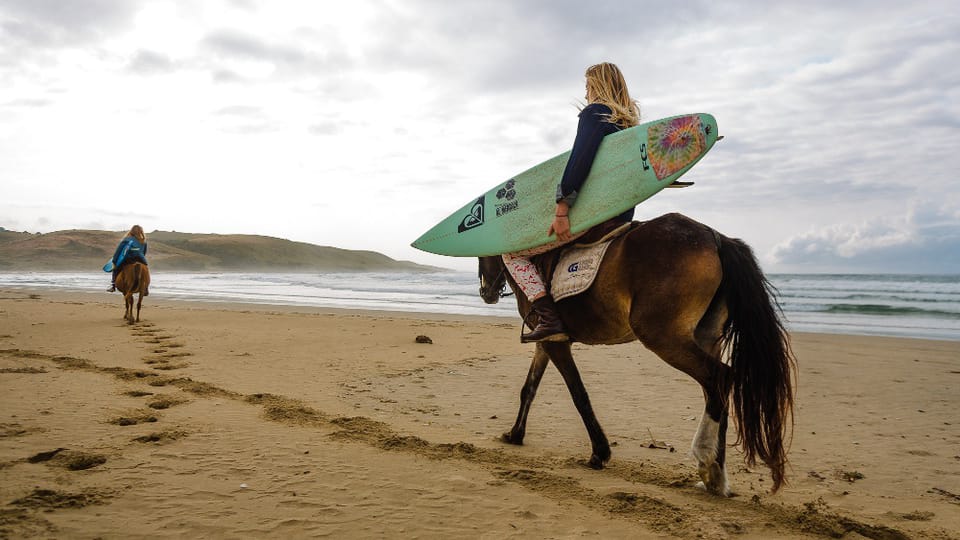
🇲🇦 Taghazout or Imsouane for a surf camp in Morocco? Community top picks: Most members leaned toward the Taghazout area, and Tamraght next door in particular. There are more than a dozen breaks around the bay, so there's something for every level and swell, and Tamraght is chiller than Taghazout. Members love Imsouane's long, rolling right and cute village, but it only has a couple of main breaks. That makes it more crowded: one member says it gets busy after 10 a.m., so go at dawn. Another warns that when the swell is big, it's even bigger in Imsouane, with strong currents. Most Taghazout and Tamraght camps run day trips there anyway.
Camps members have stayed at and loved:
Imsouane:
Mystery Surf Camp (great food, video feedback and owner Ismail is "a great host") and Olas (super social, good instructors)
Taghazout:
Original Surf Morocco (nice guys, lush food) and Surf Maroc (two villas, family-style dinners)
Tamraght:
Local Surf Maroc (friends keep going back) and Azul guesthouse
One tip: pack something for an upset stomach.
🌴 Where should a beginner longboarder surf in San Diego in December Community top picks: Tourmaline, of course. It's "foam board central" and insanely crowded, but the waves are right for what you're looking for, and Old Man's there is one member's favorite. La Jolla Shores and Pipes were also recommended, plus Swami's when it's small. For coaching, members suggested Surf Divas in La Jolla.
Two winter warnings. Waves are bigger, especially in an El Niño year. And runoff from rain and Tijuana sewage raises bacteria levels, so check the county water quality site and stay out for three days after rain. One member suggests heading north for gentler, cleaner water, like Doheny State Beach in Orange County or Oceanside Harbor. (We wrote a whole Tourmaline spotlight, by the way.)
🏝️ Where's a surf camp for advanced beginners aged 35+ in December?
Community top picks:
Costa Rica: Witch's Rock Surf Camp in Tamarindo, from a member who did the beginner camp one year and the intermediate the next. She says it's great for solo travelers and has tons of food within walking distance.
Nosara and Sámara also came up.
Nicaragua: Sardina Surf Camp in Popoyo (locally owned, affordable and "the surf guys are absolutely unreal"), Popoyo Surf Camp, Chica Brava, and Rise Up Surf
Panama: Santa Catalina for laid-back, uncrowded waves.
👉 Join us for more recs, chatter, and support
THE WIPEOUT WEEKLY SURF NEWS ROUNDUP
🗞️ 60-foot Mavericks, a 14-year-old world champ and the storm scientists are worried about

🌊 Monster day at Mavericks
The big swell delivered 50- to 60-foot faces. Many of the world’s best sat it out, but Kai Lenny surfed 10 hours, caught 50 waves and threw aerial 360s.
🏠 California gets hammered
Santa Cruz closed its beaches, 270 homes were under evacuation warnings, and cliffs are crumbling.
⛈️ An ARkStorm this winter?
Scientists warn that El Niño could bring severe flooding to California. A hypothetical ARkStorm could cause $725 billion in damage.
🏆 Leihani Zoric is world champion
At 14, she beat Steph Gilmore and Johanne Defay to become the youngest-ever ISA world champion and the first Indigenous Australian world champion.
🧠 Wave pool vs ocean
Can a wave pool give you the same buzz as the ocean? Mostly yes, they say. We say: bollocks.
🇲🇽 The QS hits Cerritos
The Pacifico Surf Open Cerritos runs November 19 to 22, live on WorldSurfLeague.com this weekend.
👉 Read the full news roundup
SUPPORT THE WIPEOUT WEEKLY
☕️ Buy me a coffee or maybe a sticker?

Enjoyed this week’s surf nonsense? Now you can buy me a coffee ☕️, or a beer, or a pizza.
It helps keep The Wipeout Weekly afloat and my fragile self-esteem above the water. But no pressure. The newsletter remains free, because you’re worth it. 😜
ALL THINGS THE WIPEOUT WEEKLY
The Wipeout Weekly—our home and digital magazine.
The Wee Surf Shoppe—explore useful, cute, and sometimes simply outrageous surf “stuffs”.
The Wipeout Weekly podcast—surf stories and guests.
All Things Surf Directory—surf retreats, learn to surf, classifieds, surf-side lodging, you name it.
Girls Who Can’t Surf Good—an 90k-member-strong private group on Facebook.
Feedback—we do want to hear from you! Whatever is on your mind, drop us a line.
⬆️ Aaaaaaand that was the last wave of the week!
If a friend forwarded this and you liked it, hit subscribe & join us! We will see you all in two weeks! 🌊
With stoke,
Zuz & The Wipeout Weekly
🏄 How was this week's edition of The Wipeout Weekly?Drop in with your pick 👇 |
Reply