- The Wipeout Weekly
- Posts
- 🏄♀️ I don't mean to alarm you, but... surfer's ear 👂
🏄♀️ I don't mean to alarm you, but... surfer's ear 👂
Plus: Surf sacrifices, Biarritz, keeping your mouth shut in the lineup, and a bit of surf news.

👋 Happy January-is-almost-over! This edition comes with a built-in apology: it’s on the scarier side—because it’s better to be safe than sorry. Sorry! 🥰
🏄♀️ Let’s surf:
I don’t mean to alarm you, but…👂
All hail Huey at your local surf sacrifice 😈
Is Biarritz ok for beginners? 🐣
Cindy’s cold water surfing tears 😭
Should I have kept my mouth shut? 🤬
Latest surf news 🗞️
SURFODRAMA
😱 I don’t mean to alarm you, but… surfer’s ear👂
You know how you sometimes wish you were ignorant and lived happily, not knowing certain things? Yeah, me too. Until I dived into the world of surfer’s ear. And since now I am terrified, I want you to be as scared as I am. Let’s panic together!
👂 So what is surfer’s ear anyway
It is an external auditory exostosis (EAE), which basically means that extra bone grows inside your ear canal.
Why? This is in response to repeated cold water and wind exposure.
How? Your body goes: “Let me protect this ear,” and overdoes it. As a result, bone growth narrows the ear canal, and the more it closes, the less you hear.
Oh—and surfer’s ear is not like swimmer’s ear. It’s not an infection, and it’s not reversible.
📊 The study that ruined surfing
Now, a bunch of ear scientists wanted to see whether wearing ear protection while surfing—specifically earplugs or a surf hood—actually helps prevent surfer’s ear.
They followed a group of surfers on the Brittany coast in France over about a year and a half. For each surfer, they asked questions about their surfing habits, took photos inside their ears, and had two different clinicians assess how blocked each ear canal was.
Then they compared how blocked the ears were, how much time surfers spent in the water, and whether they wore earplugs, a surf hood, or nothing.
This is the bad part. Ready? They found that almost 90% of the surfers had surfer’s ear (yep, almost everyone). On average, ears were about 38% blocked, and it was worse if you were a dude and had been surfing for many years.
They also learned that the more time you surf without any ear protection, the worse surfer’s ear gets—and that the hood protects you from surfer’s ear exactement zilch. Whaaaat?!
For someone who’s never worn earplugs while surfing, learning that wearing earplugs while surfing can save you from a surfer’s ear—well, holy crap.
🧠 Denial is a powerful thing
I know what you’re thinking: this is not gonna happen to me. And I said it’s not reversible, but it is fixable. It’s just a total, literal pain.
A surgeon goes into your ear and starts chiseling if you’re lucky, or drilling if you’re unlucky with your choice of surgeon. While the recovery time and how pain levels vary, it will invariably keep you out of the water for a month—or even two.
I can hear your brain cogs turning… no, no, no, nothing to do with me. I don’t surf enough. I don’t surf in cold water. My sessions never last that long. I don’t surf when it’s windy. Really, I only surf in the tropics!
😑 Here’s the annoying part
The issue is, because surfer’s ear is not as apparent—like surfer’s eye, for instance—you may not even notice until it’s too late. Unless, of course, you get your ears checked out on a regular basis.
At the very early stages, you feel that nothing is different. As it progresses, you get a feeling of blocked ears, water trapped in the ear after surfing, frequent ear infections, then muffled hearing, and eventually pain in cold or windy conditions. Crikey.
Now, how much do you need to surf for this to even become a problem? There’s no exact formula, I’m afraid. “Regular surfing” is mentioned, so we’re guessing 2–4 times a week?
But what matters more is water temperature (cold = bad—but wait, see below), wind matters almost as much as water temperature, and session length (shorter is better). Consistency, conditions, and lack of protection are the real killers here.
😱 And then it gets even worse
In the past, it was agreed that surfer’s ear develops in exposure temperatures lower than 19°C / 66°F—but the Australians spoiled it for everyone.
They did a study on surfers on the Gold Coast (warm temps) and discovered that 72% of surfers were afflicted by surfer’s ear. Argh!
🧩 So… earplugs then?
Okay, so what do we do with this information? Do we get ear protection? I guess so. According to the studies, protecting your ear canals from exposure is just the ticket.
The downside? There’s something in your ear while you’re surfing, and depending on what it is, it will affect how much you hear in the water.
But given that 70–80% of cold-water surfers develop some degree of surfer’s ear after about ten years, it feels like something we should at least consider.
There are many options. We’ve put together a “protection” list, and we’ll keep adding to it as we test more.
WORD OF THE WEEK
😈 All hail Huey at your local surf sacrifice

Huey is Australia’s god of sea and surfing, similar to Hawaiʻi’s Kahuna—but not really. First of all, you can actually trace back the etymology of “kahuna” to refer to certain professionals such as doctors, surgeons, and dentists, as well as priests, ministers, and sorcerers.
But no one can agree where Huey came from. It could’ve been Hughie, with an h—the rain god from the Australian Outback who was called upon to bring rain during the droughts of 1912. Or it may be derived from “yowie,” which is an Aboriginal word associated with thunder. Or Mr Huie, who was a real-life meteorologist near Narrandera who fired cannons to bring rain.
🎉🍻 When surf sacrifice was a thing
Huey is also mentioned in relation to “surf sacrifice.”
It has nothing to do with sacrificing red kumu fish when making surfboards in ancient Hawaiʻi or performing human sacrifice when building voyaging canoes.
Actually, surf sacrifice is all about the destruction of surfboards.
The Encyclopedia of Surfing describes it as “a spoofing beachfront pyrotechnic ritual performed in order to bring up the waves by appeasing the surf gods with an offering—the real point being to engage in a bit of misdemeanor destruction.”
You take an old board—or a couple—you soak them in gasoline or lighter fluid, you set them on fire, and there you go: you’ve got yourself a “surf sacrifice.” Or you can chuck a board off a cliff. Dealer’s choice.
It’s no longer performed, since the ’80s, when—most likely—one of the more sober surfers (beer toast is also part of the ritual) realized this might not be particularly good for the environment.
Still, it featured in multiple surf movies such as Sacrifice for Surf (1960), Innermost Limits of Pure Fun (1970), and Blazing Boards (1984).
In the early ’80s, Hawaiian company Town & Country Surfboards introduced a Tiki “surf sacrifice” design featuring a spit-roasted shark. Too much? 🤷♀️
SURF SPOT SPOTLIGHT
🤔 Biarritz: is it really okay for beginners?

We have talked about so many different surf spots around the world, but only recently turned our attention to Europe. It’d be criminal not to talk about Biarritz, the very birthplace of French surfing.
Looking at the surf forecast in January for Biarritz can make you feel nauseous. One day is 0–1ft and another—15–18ft.
🏙️ Biarritz is a town, not a surf spot
But we’re getting ahead of ourselves. First things first, Biarritz is not a surf spot per se. It’s a town, a beachfront town in southwest France. Not that far from the Spanish border, only 20 miles and facing west into the Atlantic.
As such, the surf is best September to March according to Surfline. That doesn’t stop Biarritz from being overrun with surfers all year round though.
🏄♂️ How surfing arrived in France
According to the Encyclopedia of Surfing, surfing was introduced to France in 1956 by Hollywood screenwriter Peter Viertel. While on location in Biarritz to film The Sun Also Rises, Peter recognized the quality of local waves and sent back to Malibu for his balsa surfboard. Richard Zanuck, son of Twentieth Century Fox studio head Darryl Zanuck, flew out to France with Peter’s Velzy-Jacobs.
Then the locals took to Peter’s board, tried it out and eventually started making their own surfboards. In 1959, the Waikiki Surf Club Biarritz was established and a year later it hosted the first ever French surf contest at Côte de Basques, which is one of the breaks in Biarritz.
🌊 Côte des Basques & other breaks
Cote de Basque is the most famous of the breaks. It works best mid–low tide and can be beginner friendly size-wise, but not always crowd-wise if you get my drift. And of course, mid–low means exposed rocks and strong lateral currents. So, it’s not like you can have your cake and eat it.
Then you have Marbella / Milady, which is less hyped and more forgiving, both surf condition-wise and people-wise. We also have Grande Plage, which is somewhat unremarkable—but you know, it’s a wave so it gets surfed—and much faster and heavier Les Cavaliers for experienced surfers.
⏱️ Tides, crowds, and reality
If there’s one thing you need to know about Biarritz, it’s that the surf breaks here are very tide-sensitive and can be unsurfable at high tide. It’s best to stick to mid → low.
Okay, there are two things you should know about Biarritz. Biarritz can be good for beginners. It’s literally littered with surf schools—there’s even one that’s been around since 1966! But because it’s France’s premier surf destination, you get a lot of experienced and pro surfers too.
So, proceed with caution. It’s not even that it’s localism per se. There’s just so many people for so much of the sandbank that the locals want to scream: no room at the inn, and honestly I can’t blame them. Do what you’d do at home and surf at the break best for your level. Early mornings. Shoulder season. Smaller days.
GIRL WHO COULDN’T GET HER WETSUIT OFF
🏄🏻♀️ Lived-through-it lessons on learning in your 50s: Cindy’s story
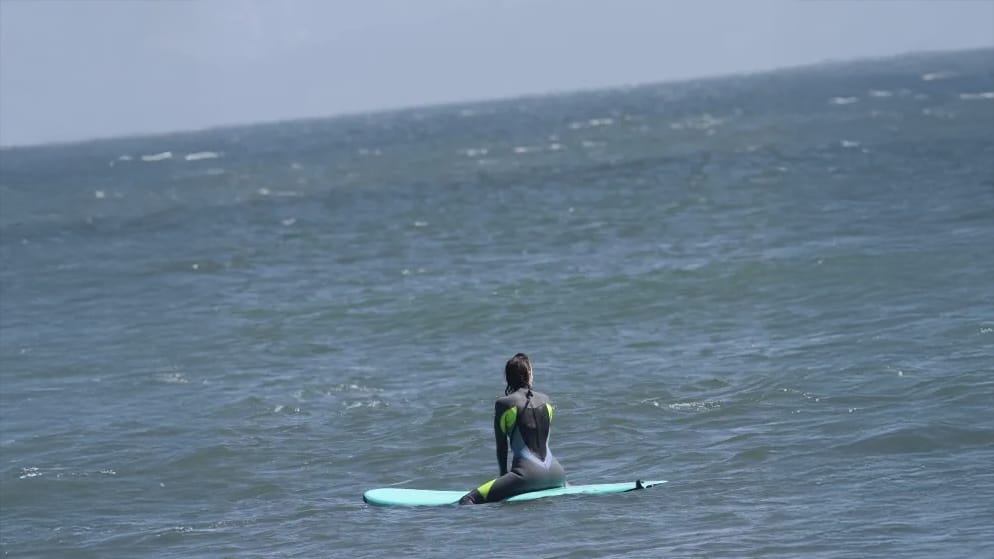
This is not a glow-up story or a “you’re never too old” tale. It’s a very honest account of cold water exhaustion, post-surf crying in a car, and general beginner delusion.
If you’ve ever thought “maybe, but probably not for me,” Cindy’s story is worth your time.
HEY ZUZ, I’M CONFUSED
🤬 Should I have kept my mouth shut?

Here’s a doozie. You make a remark in the surf and then beat yourself up about it for the rest of your life. I’ve been there. You’ve been there. Let’s go there.
Should we speak up when something bothers us while surfing? Is there ever a good reason not to? And when does opening your mouth do more damage than good?
This is one of our Hey Zuz, I’m confused stories—based on real events, questions, and concerns. Always anonymized and presented in aggregate.
And perhaps surprisingly, this one comes from a surf dude rather than a surf dudette.
THE WIPEOUT WEEKLY SURF NEWS ROUNDUP
🗞️ Surf news roundup: Morocco. New Zealand. Arizona. Bay Area. Hollywood.
🧠 Surfing therapy? That will be $3,500, please.
A Guardian essay follows journalist Annie Kelly through a trauma-focused surf retreat in Morocco, where EMDR, group vulnerability, and the grind of paddling out prove more “transformative” than actually standing up on a wave.
🌊 WSL adds New Zealand, drops South Africa
The World Surf League will replace Jeffreys Bay with Raglan’s Manu Bay on the 2026 Championship Tour, adding a rippable left-hand point and expanding the tour’s geographic—and stylistic—variety.
🏜️ Arizona gets a wave pool
A former lakeside wedding venue in Buckeye, Arizona, is slated to become a year-round surf resort with wave lagoons, reigniting debates about water use and inland surf development.
🕊️ Surf community suffers loss
Rob “Birdlegs” Caughlan, an influential surfer and environmental activist who helped shape Surfrider and preserve public beach access, has died at 82 just days after losing his wife.
🎬 Another surf movie is coming
Bali Hai, a new surf drama written by Matt George (surfer/journalist) and produced with Tom DeLonge (Blink-182), will film in Bali in late 2026 and center on family conflict set against competitive surfing.
ALL THINGS THE WIPEOUT WEEKLY
The Wipeout Weekly—enjoy stories on surf culture, skills and technique, recommended surf spots, and insider tips and tricks. Plus real stories from the lineup.
The Wee Surf Shoppe—explore useful, cute, and sometimes simply outrageous surf “stuffs”.
The Wipeout Weekly podcast—daily surf stories told with a bit of an attitude, plus conversations with our latest podcast guests. Wherever you listen to podcasts.
Girls Who Can’t Surf Good—a global, supportive community for surfers of all ages and levels. 85k members strong private group on Facebook. Sorry, girls only.
Feedback: We do want to hear from you! Whatever is on your mind, drop us a line.
⬆️ Aaaaaaand that was the last wave of the week!
If a friend forwarded this and you liked it, hit subscribe & join us! We will see you all next week! 🌊
🏄 How was this week's edition of The Wipeout Weekly?Drop in with your pick 👇 |
Reply