- The Wipeout Weekly
- Posts
- 🏄♀️ Surfing doesn't care about your surf goals 😩
🏄♀️ Surfing doesn't care about your surf goals 😩
Plus: Tails, wave pools, Newquay and the latest surf news.


👋 Happy New Year! Our regular programming has returned. It’s going to be a big year at The Wipeout Weekly (and Girls Who Can’t Surf Good!), so stay tuned—and tell everybody else! 🥰
🏄♀️ Let’s surf:
Surfing doesn’t care about your goals 😩
What’s in the tail? 🦚
There’s more to Newquay 🌊
One wave pool, two wave pools, world domination 🏊♀️
New Year’s surf news 🗞️
Scroll away at The Wee Surf Shoppe 🛍️
SURFODRAMA
😱 Surfing doesn’t care about your surf goals 😩

My surfing goals for 2025 were… I don’t actually remember. Probably something like: “go out more.” That was easily done, and since it didn’t have a numerical value attached to it—most definitely achieved.
Don’t get me wrong, I certainly don’t want to sound flippant about goal-setting. I’m a big believer in knowing where you’re going and how you’re going to get there. See The Wipeout Weekly roadmap if you must. 😉
What I want to say is this: in 2026, go easy on your surf goals—because surfing is not playing ball.
🧶 Surfing is not like knitting
You can knit a sweater in a few weeks and have something tangible to show for it. Surfing doesn’t work like that. You can surf for months—or years—and still feel like you’re back at square one on any given day. One day you tick the “goal achieved” box, the next you’re rummaging around for an eraser or some White-Out. Do we still use those?
You hear this a lot: progress in surfing is not linear. You don’t unlock skills in stages. You don’t get to perfectly replicate something just because you’ve done it before. One day you’re catching waves easily; the next you can’t get out of the whitewater. One session you feel on top of the world, the next you wonder if you’ve forgotten how to surf entirely. That’s not failure—that’s surfing.
Why is it so hard? Because it’s not just about skill. It’s also fitness, weather, conditions, crowd vibe, timing, and your actual surf routine—or lack thereof.
📱 Social media is not your surf coach
It pains me to say this, but social media doesn’t help. You see a surfluencer’s six-month progression reel and expect to hit the same milestones in the same timeframe. I’m not saying it won’t happen to you—but it probably won’t.
Measuring yourself against someone surfing a completely different wave, on a different board, with a different body and a totally different life schedule is guaranteed to lead to frustration. And frustration leads to quitting—or worse, forcing progression when it’s way too early.
Yeah, I should get a smaller board. Yeah, I should paddle out in 4–6 foot waves. And suddenly it’s not just discouraging—it’s dangerous.
🥱 The boring actually works
The good news is that we do know what works in surfing. It’s boring: going out. The old adage that you need to surf four times a week to see progress proves true again and again. It works because there’s very little time between sessions for your brain–body coordination to unravel.
The bad news? It means going out. And if you’re working full-time, have kids, live far from the ocean, or are training to become a doctor—how exactly are you supposed to conjure up four surf sessions a week, every week, for the next 50-odd weeks?
This is where the “go easy on your surf goals in 2026” thing comes in. This is the year we make peace with the fact that surfing is not a normal person’s pursuit.
🧭 Do it your way this year
By all means—set goals and track progress. According to science, you’re about 40% more likely to succeed if you can visually track your goals. So put check marks on a calendar, start journaling—whatever works for you. Accountability helps too. Rope in your surf buddy.
And turn the autopilot on. Doing something—anything—that supports your surfing every day is better than doing nothing at all. Watch surf videos. Do a few push-ups. Talk through your last session with a mate. It all adds up.
But—and I can’t stress this enough—stay realistic. Don’t beat yourself up. Don’t judge your surfing by any measure other than your surfing. Because surfing is not like anything else. And if it were easy, everyone would be doing it.
Let’s have a smashing 2026!
WORD OF THE WEEK
🦚 What’s in the tail?

Have you ever heard of a swallow surfboard tail shape? We wouldn’t be surprised if you haven’t. There are so many!
Wikipedia lists 15 types: rounded square, rounded pin, swallow, square, pin, diamond, rounded, squash, star, rounded diamond, fish, bat, swallow tail with wings (i.e. stringer), fang, and hip.
It makes you wonder where these names come from. Oh wait—the shape itself. But what we really want to know is: how does a tail affect a surfboard?
🦚 What does a tail actually do?
Short answer: the tail controls how the board releases water—and that affects speed, hold, and turning.
The longer answer is, well, longer.
The tail is the last part of the board touching the wave, so it has a huge influence on how fast the board feels, how easily it turns, how much hold you have on steeper faces, and how forgiving (or punishing) mistakes are. It’s like a steering wheel plus brakes combined.
As a beginner, you’re probably more focused on length, volume, and the general shape of the board.
But the time will come when you start thinking about your tail shape—and we will have instructional pods ready for you to make that decision.
SURF SPOT SPOTLIGHT
🌊 There’s more to Newquay than meets the eye

We’ve been reading about Kai Lenny’s trip to the legendary Mullaghmore big-wave surf spot in County Sligo, Ireland, in Stab Magazine.
At The Wipeout Weekly, we don’t care as much for waves that are actively trying to kill us, so instead we wanted to take you on a trip down south—go surfing Newquay, Cornwall, the UK’s surf capital.
🌬️ When the UK waves actually work
You can surf in the UK all year long, but of course the best—the cleanest—waves arrive not in summer, but when you can semi-freeze to death changing in the parking lot: roughly September to April.
Size-wise, we’re talking four to six feet, with the occasional push up to ten. Temperature-wise, around 45°F / 7°C when the waves are good. Sometimes it’s genuinely warmer in your 5/4 in the ocean than outside.
Newquay sits on the north coast of Cornwall, facing straight into the Atlantic. That positioning is everything. The town is fully exposed to North Atlantic swells, which means consistent waves year-round—and proper power when winter storms roll through. It also means palm trees (okay, cabbage palm trees).
📜 A quick surf history detour
There had been bellyboarding and occasional stand-up surfing in the UK prior to the Second World War.
However, the true arrival of modern surfing is often said to have occurred, according to the Encyclopedia of Surfing, in 1959, when Newquay employed full-time lifeguards on its local beaches. They sometimes used their hollow wooden paddleboards to ride waves. Visiting lifeguards from Australia brought their own fiberglass boards.
Then, in 1963, the first surfboard retailer—Bibo Surfboards—was established. By 1970, the British Surfing Association (BSA) existed, and European surf competitions were happening across the UK.
🗺️ Why Newquay really works
Enough about the history—let’s talk surf spots. Lots of surf spots.
Because what makes Newquay special isn’t one perfect wave, but the choice of decent waves within a relatively small stretch of coastline, working at different swell angles and excelling in different conditions. That’s why it works for both experienced and beginner surfers alike.
Fistral Beach
The most famous one. Long, open beach, consistent peaks, handles size well. It’s where competitions happen—and surf lessons, too. Good stuff.
Crantock
Just across the river from Fistral and often calmer, both in energy and crowd.
Towans/Great Western
More sheltered, more forgiving. These beaches catch smaller swell and are often where people head when Fistral is blown out.
Lusty Glaze & Porth
Sometimes hard to tell apart unless you’re a local.
You’re probably thinking: why would I go surf in Newquay if I live, say, in California, Australia, or near Biarritz?
I don’t know—bragging rights? Decent fish and chips? Because it’s fun. Try it.
SURF SCIENCE
🏊♀️ One wave pool, two wave pools, world domination

Wave pools weren’t actually invented for surfers. Whaaaaat?!
The earliest known wave pool dates back to 1929, when the Municipal Natatorium in Munich, Germany, built a mechanical system that created small ripples in an indoor swimming pool. These early “surf baths” were designed mostly for leisure. I would’ve loved that. Just not Germany in the ’30s.
🏄♂️ Big Surf and the early experiments
The first significant wave pool for recreational surf riding came in 1969, when Big Surf Waterpark opened in Tempe, Arizona.
Big Surf’s wave machine could produce 4-foot waves—enough to ride on a mat or a small board. Surfers tried it out, but the waves were inconsistent and mushy.
In the 1980s and ’90s, a few more parks experimented, like Typhoon Lagoon at Disney World and Sunway Lagoon in Malaysia, but the technology wasn’t yet good enough for serious surfing.
For decades, wave pools remained the realm of splashy amusement parks and didn’t capture surfers’ imaginations.
⚙️ The wave pool revolution
That changed in the early 2000s, when a new generation of engineers and entrepreneurs—like Josema Odriozola and Karin Frisch of Wavegarden, and eventually, of course, Kelly Slater and his team—decided to reimagine what was possible.
First, we had the shortboard revolution, then came the wave pool revolution.
Three big advances turned wave pools from novelties into surf training centers:
✅ Better hydrodynamics
Engineers figured out how to precisely shape the pool bottom (bathymetry) to control the wave’s form.
✅ More powerful machinery
Innovations in plunger systems, sleds, and air-pressure chambers made it possible to create longer, more consistent waves.
✅ Software control
They cracked computer modeling, which allowed fine-tuning of wave height, shape, and frequency.
🌊 The modern era of wave pools
The Wavegarden Lagoon prototype in the Basque Country was the first glimpse of modern artificial waves—smooth, shoulder-high peelers you could ride for 20 seconds.
Then, in 2015, Kelly Slater Wave Co. unveiled Surf Ranch in California: a 700-yard, high-performance right-hander that broke the internet. You’ve seen it on Instagram, for sure.
Today, dozens of wave pool projects are in development globally, from Palm Desert to South Korea.
🔧 How do they work?
Wave pools work in different ways:
️Air chambers that blast water to create different wave shapes.
A submerged hydrofoil “sled” that runs down a track (that’s Kelly’s ranch).
A giant plunger that rises and falls in the middle of a circular lake, radiating waves outward to different reefs and beaches (that’s Surf Lakes).
🤔 Why so popular?
Why not. Wave pools promise something the ocean can’t: guaranteed waves on demand.
For us beginners, potentially, that means an easier, less intimidating learning curve.
For advanced surfers, it’s a place to practice maneuvers over and over with no waiting, no crowds—any type of wave you want.
For landlocked surfers—OMG OMG OMG waves!
Downside: a session can cost $100-$500 depending on the wave pool.
🌀 Is it real surfing?
It’s early in the year, let’s not go there. Yet. 😜
THE WIPEOUT WEEKLY SURF NEWS ROUNDUP
🗞️ Surfing heals. Surfboards go to printers. Surfing stagnates. River surf is over.

The Dismantlers of the Waves.
🌊 Surf therapy charity hails record year of support
UK-based charity The Wave Project supported a record 2,674 young people in 2025, showing how surf therapy is becoming an increasingly vital early-intervention tool for mental health.
🖨️ This company thinks 3D-printed surfboards are the future of surfing
Santa Cruz startup Swellcycle is using 3D printing and plant-based materials to reimagine how surfboards are made—cutting waste while promising boards that still feel familiar underfoot.
🤔 Is surfing the world’s least-progressive action sport?
In a thought-provoking essay, Sam George argues that surfing may look stuck in the past, but its resistance to constant innovation could actually be its greatest strength.
🚫 Munich’s surfers foiled again as authorities remove access to famous river wave
After activists tried to resurrect Munich’s iconic Eisbach wave over Christmas, city authorities shut it down once more, leaving the future of one of the world’s most famous river waves uncertain.
THE WEE SURF SHOPPE
🛍️ Have a scroll through the Wee Surf Shoppe for a happiness boost
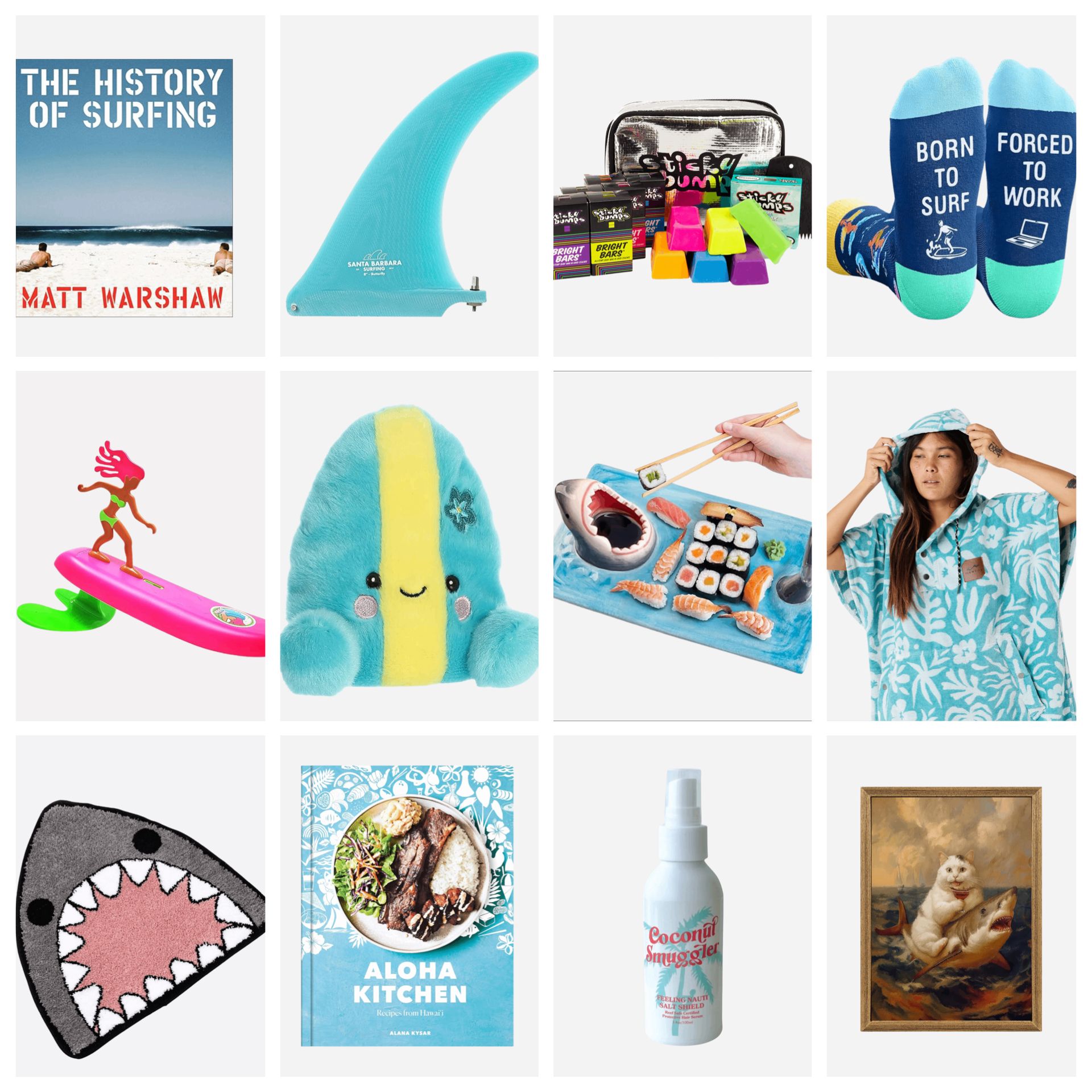
Your curated surf therapy.
This week, discover Surf Indulgences and get a little serotonin boost from cute, fun pictures of surf products no surfer actually needs.
⬆️ Aaaaaaand that was the last wave of the week!
If a friend forwarded this and you liked it, hit subscribe & join us! We will see you all next week! 🌊
🏄 How was this week's edition of The Wipeout Weekly?Drop in with your pick 👇 |
HOUSEKEEPING
More than a newsletter: You can find more stories+ on The Wipeout Weekly website.
Join us: If you’re not a part of our group yet, join Girls Who Can’t Surf Good.
Feedback: We do want to hear from you! Whatever is on your mind, drop us a line.
Reply