- The Wipeout Weekly
- Posts
- 🏄♀️ When to downsize—but like for real 😳
🏄♀️ When to downsize—but like for real 😳
Plus: Measuring waves, Hawaiian surfboard trio, biggest wave ridden, and of course-news


👋 Happy almost weekend! This edition almost reads like the big wave edition, but if you’re into ankle slappers like some of us, don’t feel discouraged.
Because our main story this week answers the second most asked question in surfing: when to downsize? 🤔
🏄♀️ Let’s surf:
When to downsize—but like for real 😳
Word of the Week: Tow-in surfing 🚤
Meet the ancient Hawaiian trio 🌺
The biggest ridden—or was it? 🌊
Some excellent surf news. Some less so. 🗞️
SURFODRAMA
😱 When to downsize—but like for real 😳

“When can I downsize” is the second most popular question among surfers. It naturally follows the first most popular question among beginner surfers: what should my first surfboard be?
We certainly do seem to care about equipment more than anything else in surfing.
🐌 You don’t have to downsize
Downsizing is not, in fact, a required milestone in your surfing journey.
The accepted truth in the surfing community is: if you’re thinking you’re ready to downsize, you’re more likely not ready to downsize.
But we do want to bring you one step closer.
Here are a few scenarios when you might consider downsizing your board:
Super early in your surfing career, you may benefit from downsizing if the original board you’re learning on is simply too big or too wide for you, making learning challenging or physically uncomfortable. This typically happens if you’re not as tall as the average surfer or your wingspan is on the shorter side.
If you’re moving to a different surf spot with completely different conditions—i.e. super fast closeouts—you may downsize if riding your original board becomes too dangerous for those conditions. Getting smacked by a 10-foot log instead a 7’6” midlength may just save your life. Or seek a surf spot better suited to the board you own.
Once you feel you can no longer progress on your original board is also a good time to consider a change.
Typically, surfers are advised to downsize when they’ve mastered pop-ups, can ride down the line, want a more responsive board, and have more control over it. All fair.
🦋 Longer boards and shorter boards catch waves differently
But one thing we tend to forget is that longer boards and shorter boards catch waves differently.
On a bigger board, you can pretty much catch a wave from almost anywhere: far back, on the shoulder, at the peak, even once it has broken.
To catch a wave on a shorter board, you generally need to take off at the peak or you’ll have a miserable time. Meaning, you’ll want to consistently be able to take off at the peak on your longer board before switching. Otherwise, you may go a very long time without catching anything.
🐛 Not all downsizing is the same
It’s worth noting that there are a few types of “downsizing,” too. You may be going from your 8ft foamie to a 7’6” or 7’4” midlength, or opting for a more dramatic downsize to a shortboard of 6’6” or smaller. Whatever your downsize journey is, you will not want to rush it.
If you must, also take into consideration that going shorter usually means less volume, which makes catching waves and paddling even harder.
The biggest tip we can offer when downsizing: don’t get rid of your original board just yet. It’s a process. And sometimes you actually need to go back in order to start enjoying surfing again.
WORD OF THE WEEEK
🚤 Tow surfing aka the thing most of us will never do

Word of the week—or more like concept of the week—is tow surfing, or tow-in surfing. That other kind of surfing that we don’t usually do, because we’re not nuts enough to surf gigantic waves.
🏊♀️ When paddling just isn’t enough
There’s a point where the ocean just gets too big. Too fast. Too heavy. Where paddling becomes just not enough. That’s where tow-in surfing comes in—the method that allowed humans to ride waves once thought completely unrideable.
Tow-in surfing involves using a jet ski to tow the surfer into a massive wave. The goal is to slingshot the rider into a building-sized swell, let go of the rope, and ride the beast before it swallows you whole.
The jet ski gives the surfer the speed they could never generate on their own—essential for catching waves moving as fast as 40–50 km/h (25–30 mph) or more. Tow surfers, by giving themselves a running start, broke the 30-foot wave barrier easily and continued riding ever-larger waves — well over 50 feet by 2001.
🔬 A Maui invention? Not quite.
You might’ve heard that the technique was pioneered in the 1990s by the Maui crew—most famously Laird Hamilton, Darrick Doerner, Dave Kalama, and Buzzy Kerbox.
But the idea for power-assisted surfing dates back to at least 1963, according to the EOS. “The surfer might be towed into the wave by a boat much like a water-skier,” California’s Mike Doyle wrote in Surf Guide magazine.
Then Hawaii’s Jim Neece tried using a speedboat-powered “water-ski takeoff” on smaller waves in 1974. He wanted to surf Ka‘ena Point—a break that gets big—but he abandoned the idea. In 1987, California’s Herbie Fletcher towed some surfers into 10-foot waves at Pipeline; in the fall of 1991, East Coast surfer Scott Bouchard was towed into a half-dozen 12-footers at a Florida break called RC’s.
Then the Strapped Crew happened. Hawaiians Buzzy Kerbox, Laird Hamilton, and Darrick Doerner began by using Kerbox’s inflatable Zodiac boat in late 1992 to tow each other into 15-foot waves at Backyards, near Sunset Beach on the North Shore of Oʻahu. Their exploits are documented in Riding Giants and Step Into Liquid. The Zodiac turned into a jet ski, and the crew went on to conquer Jaws (Peʻahi). And the rest is history.
🎨 Board design for tow-ins
Wait. One more thing. Traditional surfboards weren’t cutting it for these wave sizes, so they designed new boards—smaller than traditional guns, but heavier and with straps to stay connected during takeoffs that felt like being launched from a cannon.
Not everyone loved the idea of towing. This is from the Encyclopedia of Surfing again: “Critics said that tow-in was a blasphemy against the very nature of surfing—that drawing a bead on an incoming wave and paddling into a vertical drop was, in fact, the essence of big-wave riding. That the sport in general derived its beauty in large part from its lack of mechanization.”
And as such, the sport split in two. 99% paddle surfers, and 1% tow-in surfers—or more like surfer teams, since you can’t really do this on your own. In case you were wondering, a popular PWC (personal watercraft), the Yamaha WaveRunner, retails at $12,399.
SURF THRU HISTORY
🌺 Meet the ancient Hawaiian trio

At The Wipeout Weekly we are somewhat obsessed with the Olo, the ancient Hawaiian surfboard of royalty. We like it because it’s long, thick, heavy, and we imagine popping up on this monster would be a doddle (that’s easy in Scottish).
But the Olo didn’t exist alone. Ancient Hawaiians rode several types of surf craft, most notably the Olo, the Alaia and the Paipo. Together they formed the foundation of Hawaiian surfing.
Each board represented a different way of riding waves.
👑 The Olo
The Olo was the board of Hawaiian royalty. It was enormous—anywhere between 17 and 22 feet long and weighing close to 200 pounds depending on the source. Made from wiliwili wood, the same lightweight wood used for canoes, the Olo was reserved for chiefs under the kapu system of sacred Hawaiian laws. Even by modern standards the board was huge. For comparison, a modern longboard weighs about 25 pounds. An Olo could weigh five times that.
Despite the sandy bottom under most Hawaiian waves, getting hit by one in the lineup would have been catastrophic. The board had no fin—fins wouldn’t appear until Tom Blake introduced them in 1935—and controlling a piece of wood that large required both strength and skill. When Tom Blake built a replica Olo in 1920 with Duke Kahanamoku, he wrote that the Duke did “some of the most beautiful riding” he had ever seen on it.
🏄♀️ The Alaia
Where the Olo was reserved for royalty, the Alaia was the board for everybody. It was the standard Hawaiian surfboard and the board most often seen in old photographs of surfers riding waves with Diamond Head in the background. The Alaia sat in the middle of the ancient board spectrum. At roughly six to seven feet long and about two inches thick, it was far smaller than the Olo but still large enough to paddle effectively into waves.
The Alaia had a rounded nose, a squared-off tail and a flat plank-like shape. It was thin, finless and relied entirely on the rider engaging the rails with the wave face for control. According to the Encyclopedia of Surfing, stand-up surfing as we know it today was first developed on Alaia boards. They paddled well enough to catch unbroken swells offshore, yet were maneuverable enough to ride steep, fast sections of waves.
👶 The Paipo
At the other end of the spectrum sat the Paipo, the smallest and most intimate of the ancient boards. Unlike the Olo and Alaia, which were ridden standing, the Paipo was usually ridden prone—lying on the stomach or occasionally kneeling. These boards were typically only three to five feet long and were designed less for floating and paddling than for planing quickly across the surface of the wave.
Because the rider’s body sat so close to the water, Paipo riding offered what surfers sometimes describe as “wave intimacy.” It felt closer to bodysurfing than traditional surfing. Some historians claim Paipos were mostly used by children, while others say both adults and kids rode them. In ancient Hawai‘i they were part of a broader system of surf craft that included the Olo, Alaia and other boards.
The Paipo never completely disappeared. In Waikik’i during the early twentieth century, beach boys rode plywood Paipos at the Kuhio Beach groin known as “The Wall.” Standing on a Paipo there was considered the ultimate achievement, and surfers like Valentine “Val” Ching mastered it. Later, riders such as Rabbit Kekai, Wally Froiseth and even Eddie and Clyde Aikau spent time on Paipos as well.
Modern bodyboards owe much of their design to these small wooden boards. Historians often call the Paipo the great-grandfather of the Morey Boogie Board.
Personally, I would still love to try the Olo. At that length and volume, I’m convinced my pop-up would improve dramatically.
And now you finally know why our rooster mascot is called Olo.
SURF SCIENCE
🌊 The biggest wave ridden—or was it?

Do you know how big the biggest wave ever ridden was? Ha. No one knows, because no one can agree on the exact height.
Some of the biggest waves ever ridden have come out of places that barely looked surfable until quite recently. In recent years, Nazaré, Portugal, has become ground zero for wave-size madness thanks to its underwater canyon.
📜 The records, a few receipts missing
In 2011, Garrett McNamara put Nazaré on the map by riding a wave estimated at 78 feet, redefining what surfers thought was even possible in Europe.
That bar kept rising. In 2020, Sebastian Steudtner rode what Guinness later confirmed as the largest wave ever surfed—an 86-foot monster, also at Nazaré.
Steudtner is known for his methodical, science-driven approach, working with wind engineers, breath-hold specialists, and safety teams.
And then there’s Maya Gabeira, who deserves her own paragraph. In 2020, she rode a wave at Nazaré measuring over 73 feet—the largest wave ever surfed by a woman.
There’s a potential new record for Sebastian: 93.7 feet at Nazaré in 2024—still awaiting official verification.
And of course, you must’ve heard about Alessandro “Alo” Slebir riding a wave on December 23, 2024, at Mavericks that was claimed to be the biggest wave ever surfed—at 108 feet.
But the World Surf League says it was only 76 feet. These guys spoil everything. 😜
In case you ever wondered how imperfect measuring of the waves is, we got the answers for you.
THE WIPEOUT WEEKLY SURF NEWS ROUNDUP
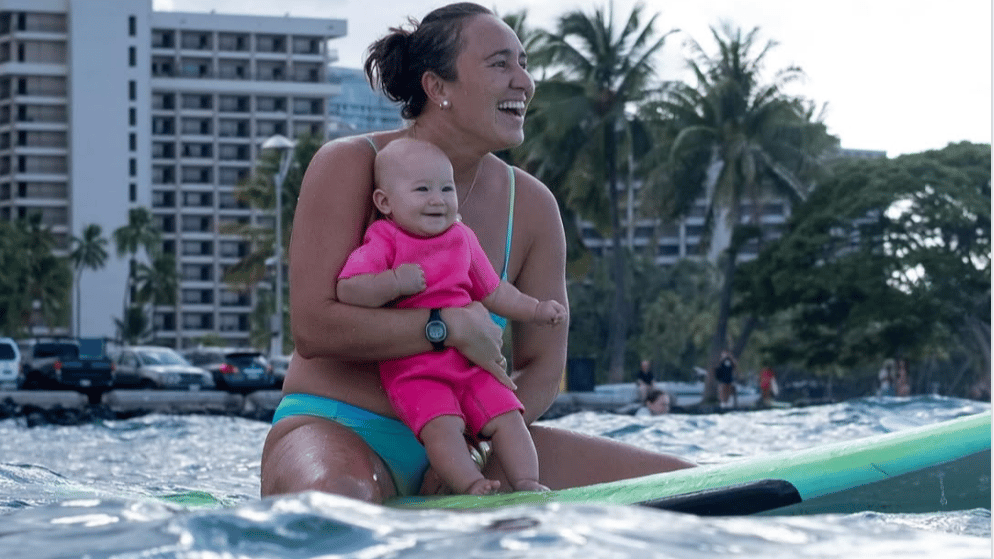
🗞️ Pro surfing moms, Olympic sand problems, surf rescues and protected waves
🏄♀️ San Clemente’s sand problem ahead of the Olympics
San Clemente is battling major coastal erosion—missing up to millions of cubic feet of sand—as officials rush replenishment efforts ahead of the 2028 Olympic surfing event at nearby Trestles.
🦺 Surf coach saves father and daughter in rip current
A SoCal surf coach jumped into the ocean fully clothed during a competition to rescue a father and daughter caught in a rip current in Oceanside—both made it back safely.
🤰 WSL introduces maternity wildcard for 2027
The WSL will allow one female surfer per season to return to the Championship Tour after pregnancy without requalifying, marking a major shift for women in pro surfing.
🏛️ California considers “surfing reserve” designation
A new bill could officially recognize iconic California surf breaks as “surfing reserves,” aiming to protect them from threats like erosion, pollution, and rising seas.
🌊 Puerto Escondido officially becomes a World Surfing Reserve
After years of grassroots effort, Puerto Escondido’s Zicatela and surrounding breaks were designated a World Surfing Reserve, protecting 10km of coastline and multiple surf spots.
ALL THINGS THE WIPEOUT WEEKLY
The Wipeout Weekly—our home and digital magazine.
The Wee Surf Shoppe—explore useful, cute, and sometimes simply outrageous surf “stuffs”.
The Wipeout Weekly podcast—daily surf stories and weekly* guests.
All Things Surf Directory—surf retreats, learn to surf, classifieds, surf-side lodging, you name it.
Girls Who Can’t Surf Good—an 86k-member-strong private group on Facebook.
Feedback—we do want to hear from you! Whatever is on your mind, drop us a line.
⬆️ Aaaaaaand that was the last wave of the week!
If a friend forwarded this and you liked it, hit subscribe & join us! We will see you all next week! 🌊
🏄 How was this week's edition of The Wipeout Weekly?Drop in with your pick 👇 |
Reply