- The Wipeout Weekly
- Posts
- 🏄♀️ Why we really need real surf stories 🫶
🏄♀️ Why we really need real surf stories 🫶
Plus: Surfing past your "best before" date, what's a Simmons, Uluwatu, and surf news.

👋 Happy National Bagel & Strawberry Ice Cream Day (don’t ask)! Here’s what we learned this week: there’s no optimal age to start surfing. You’ll get murdered in that lineup whether you’re 17 or 71. Because that’s surfing. 🥰
🏄♀️ Let’s surf:
Why we really need real surf stories 🫶
Badass Bonnie: 75 and still surfing 🔥
What’s a Simmons, again? 🤯
What makes Uluwatu Uluwatu 🌊
The best surf news we could find 🗞️
SURFODRAMA
😱 Why we really need real surf stories 🫶

We usually kick off every newsletter with a bit of surfodrama. You know: “how not to love your surfboard to death”, “why is surfing so bloody tiring”, “are you and your surf spot okay?”.
This week is an exception. Although you could argue that drama is inherent in surfing, therefore any topic is automatically a surfodrama!
You can now scroll to the Badass Bonnie story below—or just hang in here with me for another minute. It won’t take long, I promise.
Telling and sharing real stories from the lineup is my favorite thing about The Wipeout Weekly and the Girls Who Can’t Surf Good community. I’m not a particularly sentimental person, but these stories get me every time.
Whether it’s someone getting into surfing against all (or just some) odds, or a post about whatever usual-unusual thing happened in the lineup this week—I love reading them. I suspect you do too.
We need these real surf stories because they show us what’s possible. They give us permission to feel the way we feel about surfing. They remind us that we’re not in this completely, utterly alone.
Good news: we have enough stories to tell you for another few weeks.
Bad news: we only have enough stories to tell you for another few weeks.
So if you have a story to tell, give us a bell.
GIRL WHO CAN’T SURF GOOD BUT SHE IS DOING IT ANYWAY
🏄🏻♀️ Badass Bonnie still surfing at 75

Bonnie: doing what she was born to do.
If you’ve ever wondered whether you should start learning to surf, or questioned whether you should just stop (because this surfing thing is waaaay too hard), this story is for you.
Meet Bonnie. For her 65th birthday, she went on a solo trip to Costa Rica, saw a sign for surf lessons, and signed up. Ten years later, she’s still surfing, totally hooked, and loving it.
I can pretty much guarantee Bonnie’s story will make you want to throw any lingering doubts about surfing wherever it is that doubts go to die. Regardless of how old you are and what your level of experience is.
WORD OF THE WEEK & SURF THRU HISTORY
🤯 What is a “Simmons”, again?

Bob Simmons with a Simmons.
In short, a Simmons is a board designed by Bob Simmons, a surfer from Los Angeles, California. Now, onto a longer, more fascinating story.
Simmons wasn’t a typical surf industry figure. A high school dropout who nevertheless passed Caltech’s entrance exam, he studied engineering and mathematics, worked for Douglas Aircraft during and after World War II, and consumed technical literature obsessively—hydrodynamics, planing hull theory, drag coefficients, naval architecture.
In 1946, he obtained a detailed MIT study on planing hulls and began doing something no one else in surfing was doing at the time: applying formal scientific theory to surfboard design.
🧠 The original surfboard scientist
He was a surfboard scientist. While other shapers experimented through trial and error, Simmons calculated speed, drag, turbulence, rider weight, board volume. He wanted to know not just what worked, but why it worked that way.
As you might imagine, this made him deeply annoying to many of his shaper friends.
His personality didn’t help. He was loud, scruffy, opinionated, socially abrasive, and frequently got into fights at surf spots. He was beaten up at Malibu, punched at San Onofre, and famously returned to Palos Verdes Cove at night with an axe to destroy boards after being attacked there earlier. What a joy.
But still, a surfboard design revolutionary.
🏄♂️ What surfboards looked like before Simmons
When Bob started surfing in the late 1930s, surfboards fell into two main categories. We had solid wooden planks that were heavy and barely maneuverable, and hollow “cigar box” boards that were lighter, but still difficult to control. Keep in mind the fin was not invented until 1935, so this was all still very new.
Overall the late 30s boards in California (Hawai’i was doing slightly better) were hard to paddle, harder to turn, and limited in how they could be ridden on a wave.
And as Bob was tall, lanky and physically limited by a fused left elbow, he felt those limitations acutely, and was determined to solve them.
🧪 The materials that changed everything
We’ll get into the Simmons shapes in a moment, because it’s the materials Bob used that changed the history of surfboard design.
While working at Douglas Aircraft, Bob encountered fiberglass, then a new aerospace material. By the mid-1940s, he was among the first surfers to coat boards in resin-saturated fiberglass cloth, dramatically increasing strength and water resistance.
Even more radical were his polystyrene foam “sandwich” boards, built with a foam core and thin plywood skins bonded together with industrial adhesives. These boards solved the problem of resin dissolving foam and predated commercial polyurethane foam surfboards by nearly a decade.
Depending on materials, Simmons boards weighed 20 pounds less than standard boards of the time—sometimes as little as 45–55 pounds, which was revolutionary then. And that’s how we eventually got modern epoxies, ladies and gents!
📐 The Simmons shape
Now, about the shape. Bob’s boards were funny looking by today’s standards. They had extra wide outlines of about 24 inches, square or diamond tails, spoon-shaped noses, very little rocker and usually twin fins placed near the rails to stabilize the wide tail.
As a result, these boards were designed to plane, not knife through the water. Bob didn’t care much for tight turns; he wanted to ride a wave as far as possible, even if it was small.
Even though many surfers didn’t like Bob’s boards—and even though shapers like Joe Quigg and Matt Kivlin refined his ideas into more user-friendly designs—they used (sorry) stole his concepts.
As shaper Reynolds Yater put it:
“Kivlin and Quigg made better boards—but would they have done that if Simmons hadn’t been doing what he was doing?”
Bob died at 35. He died as he lived, struck in the head by his own board, and drowned at Windansea in San Diego. He was inducted into the Surfing Hall of Fame in 1966.
SURF SPOT SPOTLIGHT
🌊 What makes Uluwatu Uluwatu
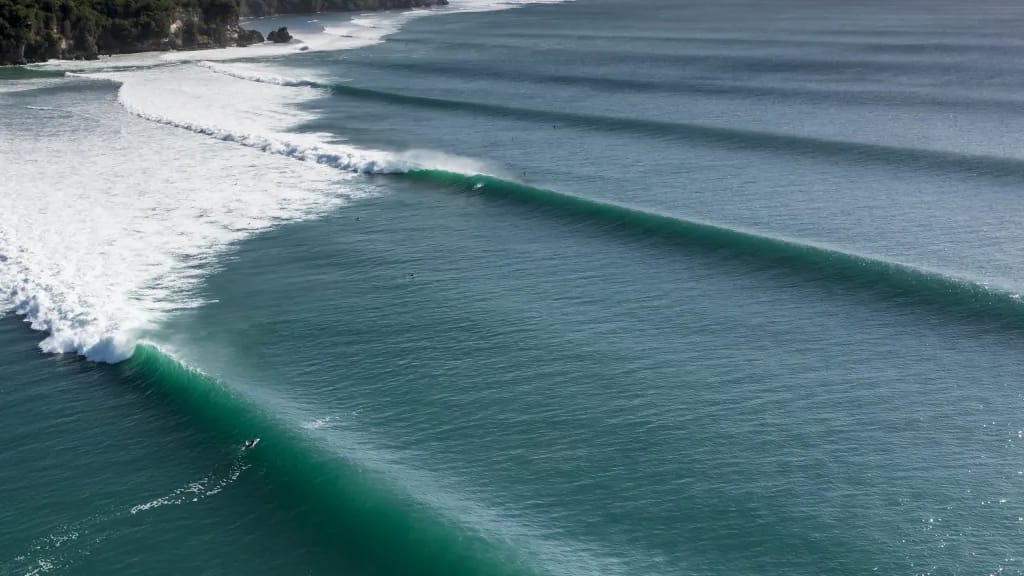
I have never been to Bali, but I find researching Uluwatu extremely romantic. To the point, I would just go to see it. And then head over to Kuta for some beginner-friendly waves. The wave sounds delightful, though.
🌍 Where Uluwatu actually is
Uluwatu—known simply as Ulu to anyone who’s ever dragged a board bag across Bali—is one of those places that feels almost mythic. It sits on the southwest edge of the Bukit Peninsula, tucked beneath cliffs crowned by Pura Luhur Uluwatu, a temple whose name roughly translates to “the last stone.”
Below it, the reef stretches out like a runway for left-handers that seem to peel into eternity. What surfers discovered here in the early ’70s wasn’t just a new wave; it was the gateway to the entire chain of dreamlike Indonesian reef breaks that would define generations of surf wanderlust.
🌊 When Uluwatu shines
Uluwatu comes alive from May through October, when distant winter storms in the Indian Ocean send line after line of swell toward the island.
Four-to-eight-foot days are the bread and butter of the season, punctuated by the occasional oversized pulse that spikes into the double digits. Add in the reliable southeast tradewinds, and you get that silky, groomed perfection you watch in the surf movies.
🪸 The reef, the sections, the labyrinth
The reef itself is a bit of a labyrinth. Here’s how it’s described by Matt Warshaw in the Encyclopedia of Surfing🙃
“Uluwatu’s sweeping, coral-covered lava reef has three main sections: 1) Outside Corner, a shifty wave located farthest out to sea, is best on lower tides, starts breaking at six feet, can hold form up to 15 feet, and sometimes produces rides up to 300 yards long. 2) The Peak, or Inside Corner, is the main surfing area, located just in front of a beach-access cave, and features a shifting set of peaks when the waves are between three and six feet. 3) Racetrack, further inside, is Uluwatu’s five-star section; a long, fast, hollow wave that gets bigger as it coils and spits down the reef. Racetrack requires a mid-sized swell and mid-range tide.”
👥 Crowds, critters, and consequences
Crowds are as much a part of modern Uluwatu as the reef itself. Its closeness to Kuta and its decades of fame mean the lineup can feel like an international arrival terminal, with a hundred surfers vying for position on a good day.
Sharks and sea snakes do occasionally swing by to say hello, but the real danger is the lava reef waiting just inches below the surface, particularly along Racetrack where the ocean does not care how fancy your travel insurance plan is, even if it includes “surfing.”
🎥 The discovery and the mythology that followed
Uluwatu was officially “discovered” in 1971 when filmmaker Alby Falzon showed up with fourteen-year-old Steve Cooney and California surfer Rusty Miller. The footage they shot for Morning of the Earth—absolutely spectacular—started the Ulu craze.
By the mid-’70s, Balinese surfers like Ketut Menda, Made Kasim, and Gede Narmada were sharing the lineup with icons such as Gerry Lopez and Peter McCabe, and Ulu began appearing regularly in magazines and films.
Competitions also started popping up, with the first pro event held in 1980 and many more to follow.
Over the years, Uluwatu has starred in plenty of surf movies—Free Ride, Bali High, The Sons of Fun, Year of the Tiger, Ulu 32—and a long list of guidebooks that cemented its status as one of the best waves on Earth.
Surfing magazine once ranked it among the world’s top 25, though eventually the spotlight shifted toward the hyper-hollow Padang Padang just up the reef.
🚫🏄♀️ So, is Uluwatu for beginners?
By now you know it’s not really a beginner wave, because even if the waves are small, you get the reef. Assertive intermediate up, because crowds.
THE WIPEOUT WEEKLY SURF NEWS ROUNDUP
🗞️ Surfer saved in Ireland. Surfer saved in Puerto Rico. Surfer saved from a shark. Surfers saved from the ocean.

🚁 Surfer airlifted from the Clare Coast, Ireland
A surfer was rescued from the rocks near Doonbeg after getting into trouble at Riley’s Wave, with challenging conditions requiring a helicopter winch rescue—the third such incident in the area in recent months.
🛟 Surfer saved in Puerto Rico (after 30 hours on the rocks)
A 68-year-old surfer went missing near Aguadilla and was found alive the next day, waving for help after spending 30 hours stranded on offshore rocks before being hoisted to safety by the U.S. Coast Guard.
🦈 Surfer attacked by shark in Northern California—walks away
A surfer near Gualala survived a shark attack that destroyed his board but left him with only minor injuries, a rare and lucky outcome amid increased shark activity along the Northern California coast.
🏜️ Surfers saved from the ocean (by surfing not in the ocean)
A new luxury wave pool planned for southern Utah promises perfect, predictable waves in the desert—raising big questions about water use, sustainability, and the future of surfing itself.
ALL THINGS THE WIPEOUT WEEKLY
😜 There’s more to The Wipeout Weekly than this newsletter ⚱️

The Wipeout Weekly—we like to think of it as a surf magazine. Enjoy stories on surf culture, skills and technique, recommended surf spots, and insider tips and tricks.
The Wee Surf Shoppe—not much of a shop, more like a scrolling experience. Explore useful, cute, and sometimes simply outrageous surf “stuffs”.
The Wipeout Weekly podcast—in case you don’t have time to read, you can listen instead. Stories told with a bit of an attitude, plus conversations with our latest podcast guests. Wherever you listen to podcasts.
Girls Who Can’t Surf Good—a global, supportive community for surfers of all ages and levels. 85k members strong private group on Facebook. Sorry, girls only.
And more to come soon!
⬆️ Aaaaaaand that was the last wave of the week!
If a friend forwarded this and you liked it, hit subscribe & join us! We will see you all next week! 🌊
🏄 How was this week's edition of The Wipeout Weekly?Drop in with your pick 👇 |
HOUSEKEEPING
More than a newsletter: You can find more stories+ on The Wipeout Weekly website.
Join us: If you’re not a part of our group yet, join Girls Who Can’t Surf Good.
Feedback: We do want to hear from you! Whatever is on your mind, drop us a line.
Reply